
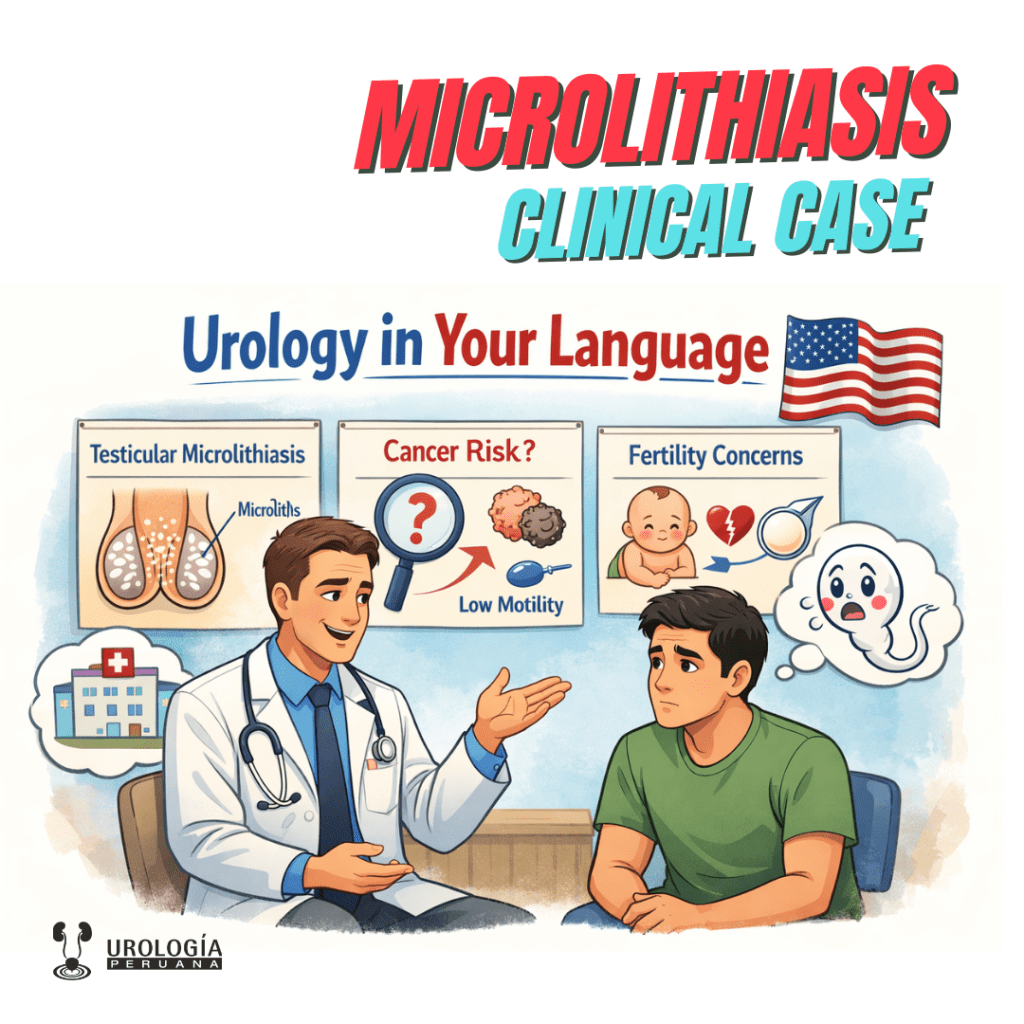
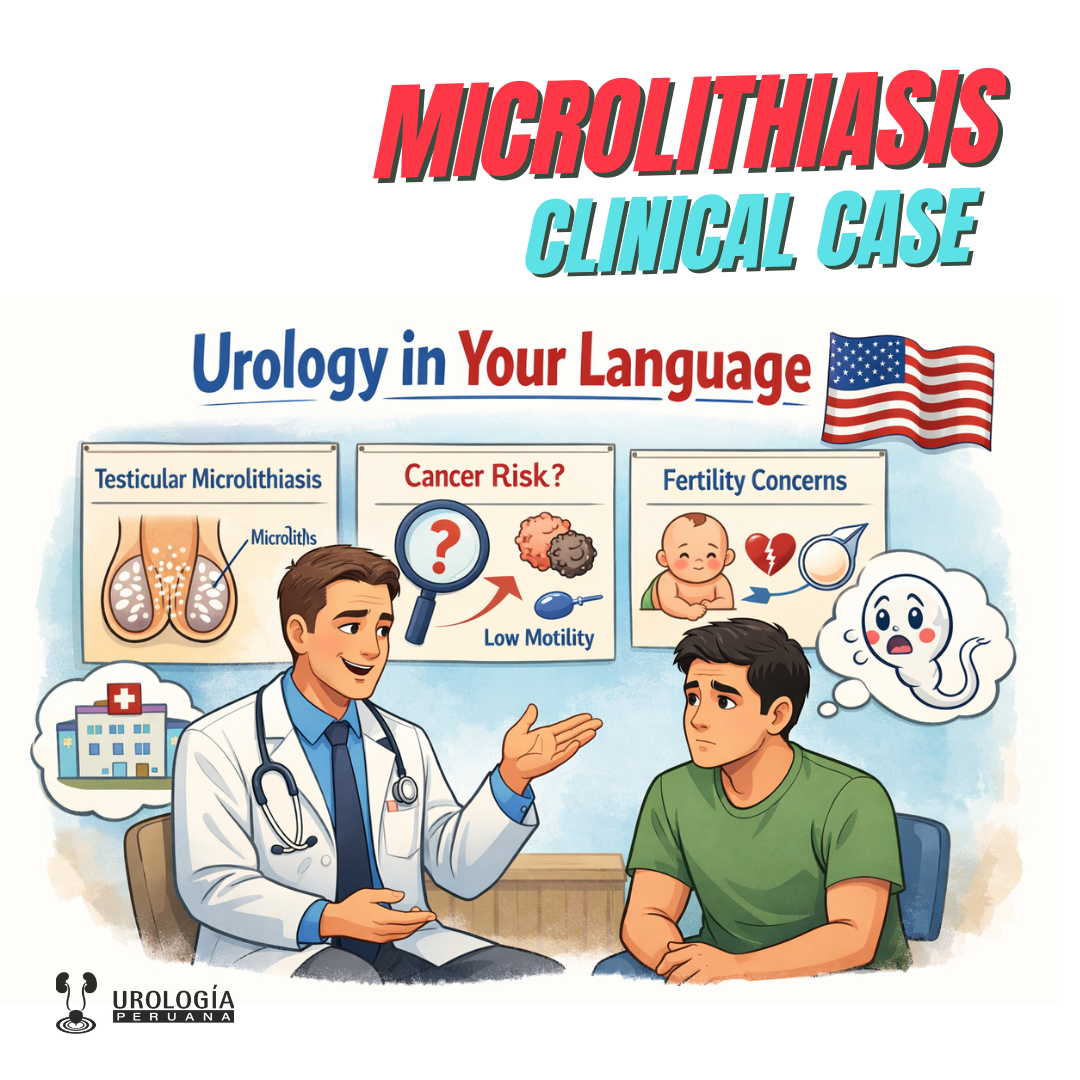
Clinical Case Description
A 21-year-old male was diagnosed with bilateral testicular microlithiasis eight months ago during a routine scrotal ultrasound examination. He denies any known risk factors for testicular malignancy, including family history of testicular cancer, cryptorchidism, prior testicular tumors, or testicular atrophy.
A recent semen analysis revealed a sperm concentration of 67 million spermatozoa in a total ejaculate volume of 2 mL. However, approximately 95% of the sperm demonstrated poor motility.
The patient reports persistent bilateral testicular discomfort and significant anxiety regarding the potential risk of developing testicular cancer and possible future infertility. He expresses fear about his reproductive capacity and long-term prognosis.
Currently, he seeks medical guidance and reassurance regarding:
- The association between testicular microlithiasis and testicular cancer risk
- The significance of reduced sperm motility
- Appropriate follow-up and surveillance strategies
- His future fertility potential
Understanding Testicular Microlithiasis and Your Cancer Risk
First, take a slow breath. Your situation is much less dangerous than you fear, and there is good news.
I’ll explain clearly and calmly as a urology professional would.
What is testicular microlithiasis?
Testicular microlithiasis means:
- very small calcium deposits inside the testicle
- seen only on ultrasound
- usually no symptoms
- very common in young men
It is not cancer and not a precancerous tumor by itself.
Many healthy men have this finding and live their entire lives without any problem.
Does microlithiasis cause cancer?
This is the key point:
👉 Microlithiasis alone does NOT cause cancer.
Modern urology guidelines show:
If you have no risk factors, your cancer risk is almost the same as any normal man.
Risk factors would be:
- previous testicular cancer
- undescended testicle (cryptorchidism)
- strong family history
- testicular atrophy (very small testicles)
- infertility with severe abnormalities
You said you do not have risk factors, which is very reassuring.
So your probability of cancer is very low.
Not zero (nothing in medicine is zero), but very low.
About your sperm test (67 million)
This is actually good news.
Normal values:
- Count: >15 million per mL
- Total count: >39 million
You have 67 million, which is excellent.
So:
✅ You produce sperm well
✅ You can become a father
About poor motility (95% low movement)
Motility problems are:
- common
- often temporary
- caused by stress, infection, heat, smoking, poor sleep, anxiety, or lifestyle
They are not related to cancer.
And they often improve.
Helpful tips:
- avoid smoking
- avoid tight underwear
- reduce heat (no hot baths/laptops on lap)
- exercise moderately
- sleep well
- antioxidants (vitamin C, E, zinc, CoQ10 if available)
About your pain
Microlithiasis does not usually cause pain.
Pain is more commonly from:
- muscle tension
- epididymitis (inflammation)
- anxiety-related pelvic floor tightness
- varicocele
- minor infections
Stress can actually increase genital pain a lot.
When someone is very anxious, the brain amplifies normal sensations.
What should you do for safety?
Simple monitoring is enough:
✔ Self-exam once per month
✔ Ultrasound once a year
✔ See a doctor if you feel:
- new lump
- rapid enlargement
- hard mass
- persistent swelling
That’s all.
No surgery, no treatment needed.
The most important message
Based on what you told me:
- Microlithiasis alone → low risk
- Good sperm count → fertility possible
- Young age → very good prognosis
👉 Cancer is unlikely.
👉 Fatherhood is very possible.
Your biggest problem right now sounds like fear, not disease.
And fear can make every small symptom feel dangerous.
Si lo prefieres, también puedo adaptarlo a:
✅ estilo más académico (para publicación)
* Informes*
📆 Citas en línea y presenciales
☎️ 989 662 887
📞 (01) 332-4009
Av. Brasil 935. Jesús María. Lima. 🇵🇪 15072.
Urología Peruana Dr. Luis Susaníbar





 Urología Peruana. Dr. Susaníbar